
Why Hasn't Iran Sunk an American Aircraft Carrier?
And what's up with anti-ship ballistic missiles?

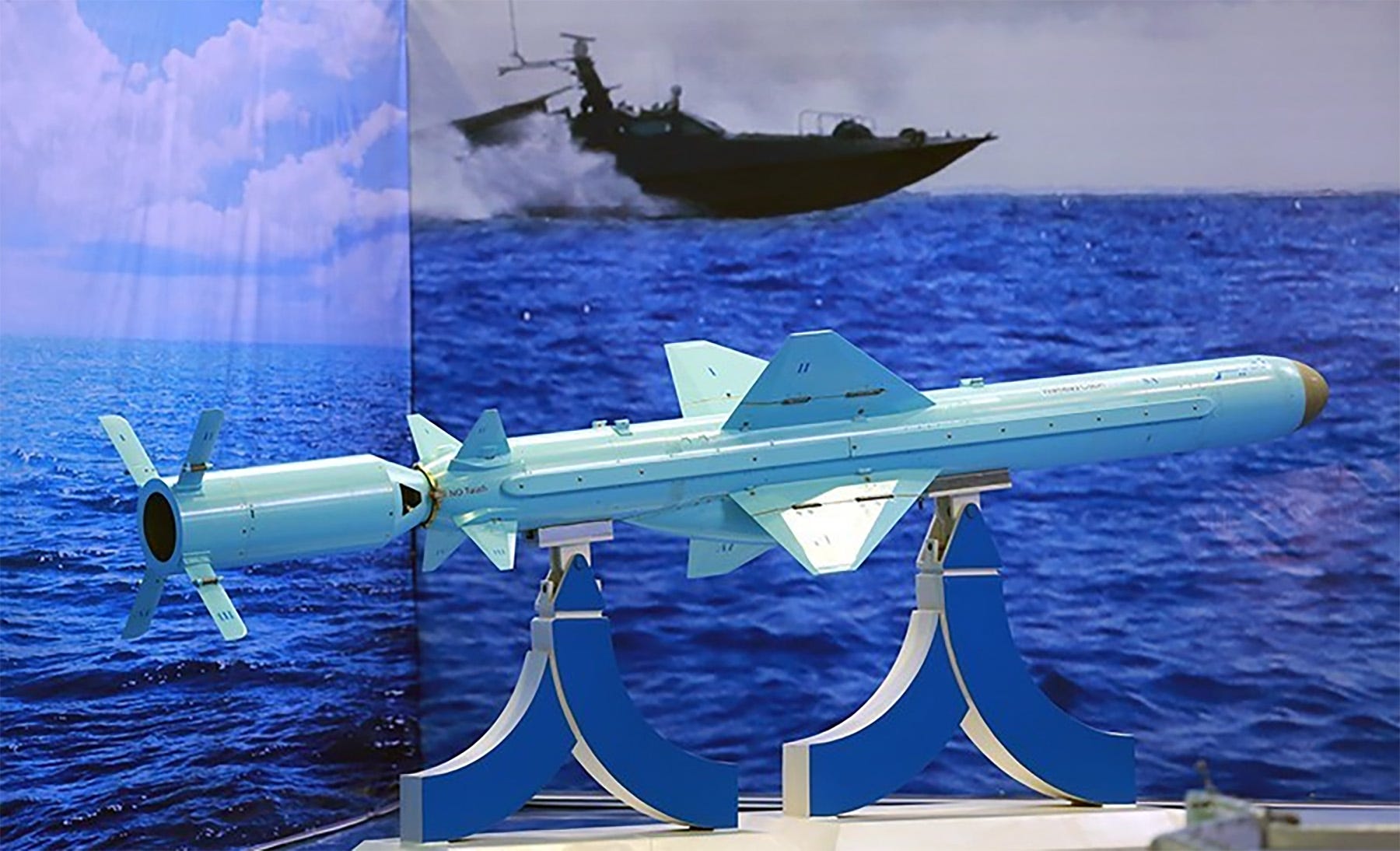
The Iran War has so far unfolded in a way that could be described as “predictable,” or obvious. The closure of the Strait of Hormuz was predicted by many, as were Iranian attacks on Gulf oil infrastructure. The asymmetry between modern ballistic missiles and ballistic missile defense was also known and predictable based on the performance of the Patriot in the war in Ukraine. Iranian ballistic missile performance specifically—and especially their ability to penetrate Israeli and American air defenses—was well known to anyone who closely observed Operation True Promise I in April 2024. The shortage of American standoff munitions and missile interceptors was publicly known before the war. The vulnerability of MALE drones could be predicted from observing the Red Sea Crisis. Even casual observers are well aware of the battlefield revolution Iranian drone designs have triggered in Ukraine. That American and Israeli air forces would fail to establish long-term, constant, and total control over Iranian skies could have been predicted by anyone who dug closely into Israeli air attacks on Iran in 2024, or, again, the war in Ukraine.
There is, however, one glaring exception to this rule: that the Iranians have, apparently, failed to seriously damage an American naval vessel, and an aircraft carrier in particular. Given the impressive showing by Iranian missiles and the comparatively poor performance of American air defenses, this seems counterintuitive. If Iranian ballistic missiles have the capability to strike targets from hundreds of miles away with pinpoint accuracy, if they’re able to maneuver in flight, attain hypersonic terminal velocities, and penetrate the most modern and sophisticated air defenses in the world, why are American carrier strike groups able to loiter a few hundred kilometers from Iranian shores?
Before getting into the meat of this question, let’s get some caveats out of the way. The only thing we truly know, because it’s been confirmed in official statements by both sides, is that the Iranians have targeted US Navy assets. We don’t know if they’ve managed to hit an American ship, and there’s no strong evidence that they have, but we can be certain they haven’t sunk one. We don’t know how many anti-ship missiles and drones the Iranians have expended in their targeting efforts. We’ll avoid speculating on the possibility of American cover-ups of damage to naval vessels in this piece.
We can't rule out that the Iranians are deliberately withholding a catastrophic strike. In this view, they could be limiting themselves to what are effectively warning shots to keep the American naval force in the Arabian Sea at a distance. This could make sense from a strategic perspective, as it would control the rate of escalation. Striking American bases in Jordan, for example, could plausibly be construed as lower on the Iranian escalation ladder than striking an American aircraft carrier, which is the enduring symbol of American military power. It’s long been speculated that the American government would be forced to respond to the sinking of an aircraft carrier with a retaliatory nuclear strike, though there is no evidence this is US military doctrine.
What we’ll do in this piece is focus narrowly on why Iran might have a hard time hitting an American aircraft carrier, provided they were determined to do so. This is an important question, because a surface-level analysis might assume Iran’s startling ability to precisely hit static ground targets would translate to anti-ship operations. But this is not necessarily the case. To understand why, we’ll trace the history of anti-ship missile (ASM, sometimes AShM) development and the constraints of ballistic missile design.
Falling With Precision
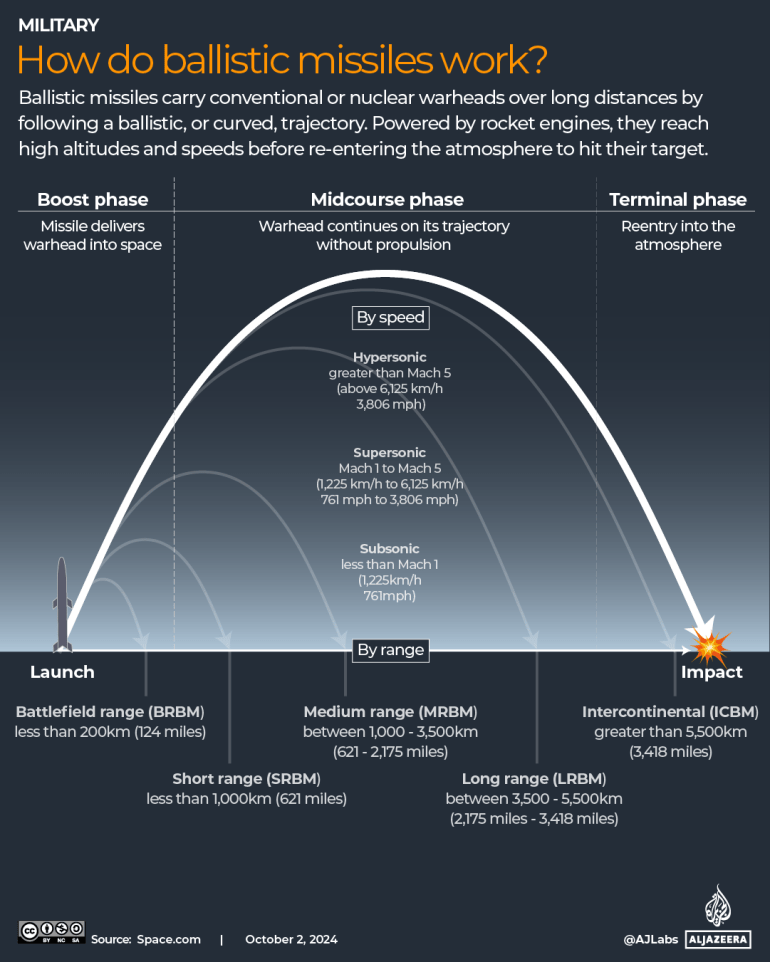
First, it’s important to understand how the most basic form of ballistic missile functions. Ballistic missiles begin their trajectory with the “boost phase,” a powered phase that delivers all the kinetic energy the missile requires to reach its target. This is the phase in which guidance traditionally occurs, meaning the missile spends the majority of its ballistic arc falling unguided to its target. The missile’s guidance system contains accelerometers and gyroscopes. The guidance computer takes these inputs and compares them against the missile’s launch position and a predetermined, static target, finding the missile’s deviation from its desired track and correcting it using control surfaces like exhaust vanes, fins, and engine gimbals. This is called inertial navigation, and it dates all the way back to the German V-2 rocket, which used an analog computer.
Inertial guidance systems are entirely self-contained. It emits nothing and receives no external signals. Therefore, it’s impossible to jam or spoof. It doesn’t require a complex seeker, and the basic technology it relies on has existed for nearly a century. But inertial guidance has drawbacks. The sensors involved are not perfect. Gyroscopes have drift, and accelerometers have bias. There are limits to how precisely a rocket motor can be switched off, and variance in the atmosphere and even gravity across the earth’s surface can introduce error.
Decades of ballistic missile development have progressively reduced the error rate of inertial guidance systems. Missile accuracy is measured in “circular error probable,” or CEP, which is the radius of a circle drawn around the target in which 50% of the projectiles will land. The V-2 rocket had a CEP of around 15 kilometers, meaning that if the Germans fired 100 V-2s at a given target, 50 of them would land within a 15 km radius of it. This made it useful only for random terror bombings.
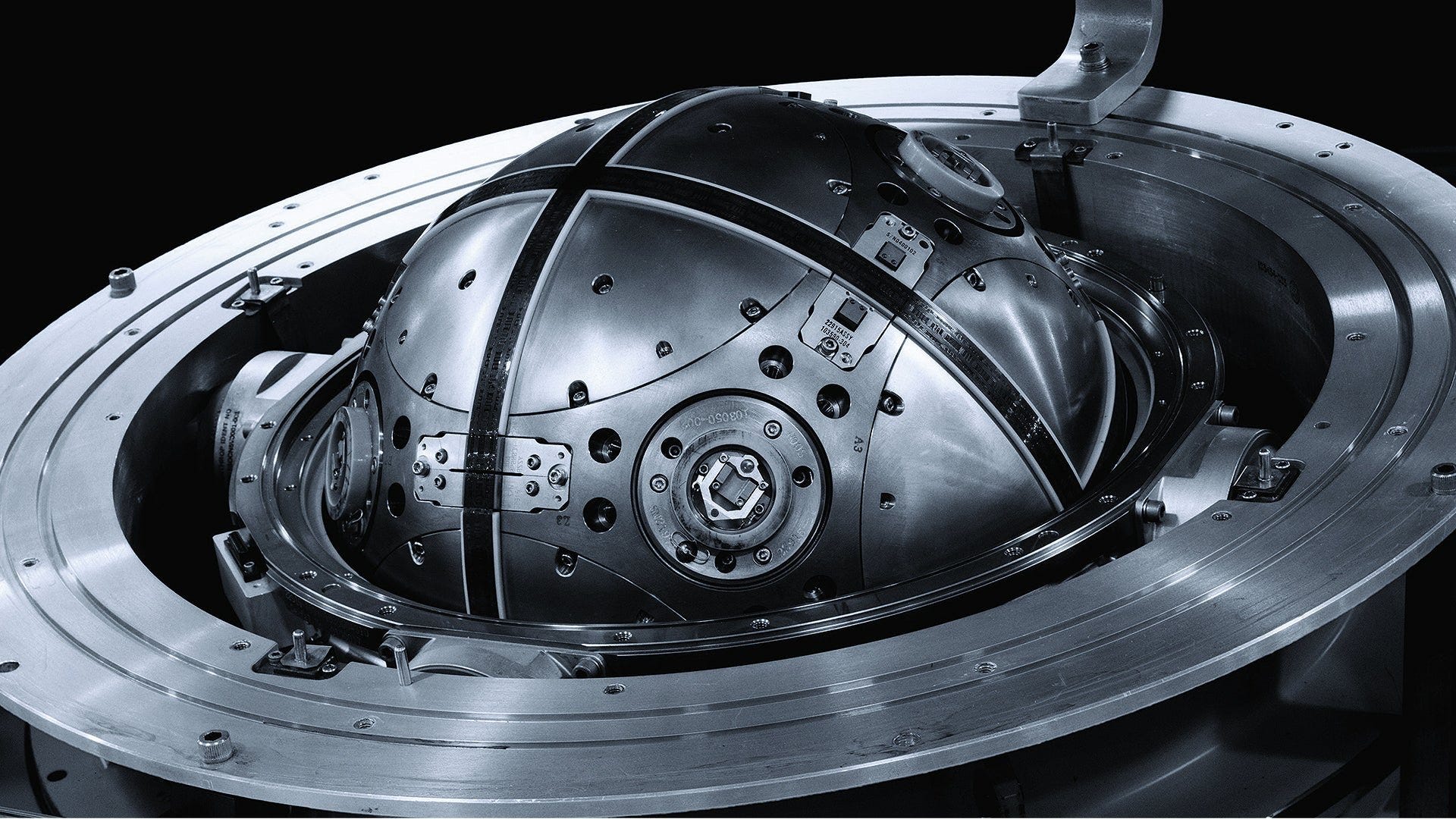
Engineers attacked the weak points of inertial navigation systematically after the introduction of the V-2. Gyroscope quality has been improved, systems now account for the variation of gravity across the earth’s surface, launch points are surveyed with extreme precision (inertially guided submarine-launched ballistic missiles, or SLBMs, have never been as accurate because they’re launched from a mobile platform), and guidance computers are massively more sophisticated than the analog computers of the 1940s. By the 1960s, inertial guidance was more than sufficient to produce acceptable CEP for missiles used in countervalue strikes, with the massive damage radius of nuclear warheads. Modern inertial guidance systems are capable of achieving a CEP measured in the tens of meters, or even less. Radio-inertial, GPS, and stellar-inertial systems have been developed to supplement purely inertial guidance to improve accuracy.
The Problem With a Moving Target
But inertial guidance is wholly insufficient for striking a moving target. To demonstrate why, we can plot out a series of circles representing the distance an aircraft carrier can travel within a given timeframe while moving at 30 knots:
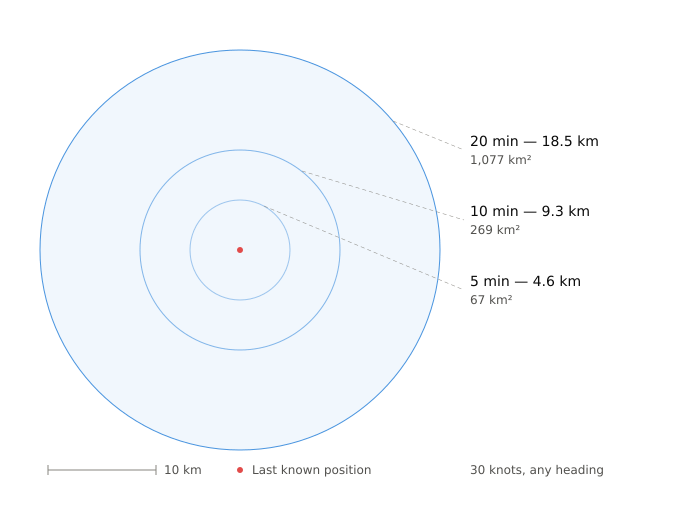
This diagram is deliberately simplified, and doesn’t account for the target’s heading, wind, the constraints of carrier operations, and so on, but it gives us a rough sense of the problem. Within five minutes of launch, the target could be potentially anywhere within an area the size of Manhattan. Within ten minutes, that area exceeds four Manhattans. By the time 20 minutes have passed, it’s 18 Manhattans, or a circle with the approximate width of the Strait of Hormuz’s narrowest point. A Nimitz-class aircraft carrier has a deck area of 0.02 square kilometers, or 0.027% of the 5-minute target area. Even with a missile capable of hitting a postage-stamp-sized target with consistency, it would be like trying to thrust one’s hand into a haystack and find a needle by sheer luck.
The First Attempt
The solution, then, is to introduce a seeker. The first serious attempt at this was Soviet, because the Soviets recognized the need to create a counter to American aircraft carriers. In the mid-1960s, the Soviets took the existing R-27 SLBM and developed a new terminal guidance system driven by a passive radar seeker. The resulting platform was dubbed the R-27K. And while the missile was successfully tested against a mobile target barge, it had severe limitations that would have prevented its operational use even if it weren’t constrained by the SALT treaty. These limitations elucidate the extreme complexity involved in designing an ASBM.
The Soviet selection of a passive radar seeker for the R-27K was logical. A passive seeker simply detects a radar emission—it doesn’t have to generate its own radar signal, fire it off into the target area, and wait for it to return. The round trip of an active seeker imposes power and time constraints, and requires a complex transmitter (keep in mind all of these components have to fit inside the missile itself). The R-27K likely activated its passive seeker during the midcourse phase of flight, while it was outside the atmosphere. This bypassed the need to design a seeker capable of either transmitting or receiving through the plasma sheath that surrounds a ballistic missile during atmospheric re-entry, its terminal phase.
The drawbacks of this exo-atmospheric passive radar guidance system are severe. Because the R-27K was unguided in its terminal phase, it was inaccurate. Passive radar guidance didn’t allow fine-grained target discrimination, i.e., the missile could detect an emitting target, but couldn’t identify precisely what that target was. The system still had potential utility because it was armed with a nuclear warhead. Even with poor target discrimination and a CEP measured in hundreds of meters, it could still potentially deal damage to its target. But the Achilles’ heel of the R-27K was EMCON, or emissions control. If the naval force it was targeting stopped emitting during its targeting phase, it would have nothing to lock on to. Because of the enormous speed of ballistic missile systems, and the short window for detection and navigation, even a brief interruption in emissions from the target would be enough to severely degrade the missile’s accuracy. As anti-radiation missile technology developed, naval forces increasingly began to practice EMCON.
The Case for Going Slow
By the time the R-27K entered its testing phase, Soviet engineers had already resolved most of the drawbacks of ASBMs by developing and fielding an alternative: the anti-ship cruise missile. Cruise missiles bypass many of the constraints of ballistic missile platforms simply by virtue of being slower. There is no plasma sheath, allowing constant guidance all the way up to the moment of impact with the target, and the transmission and reception of external signals. Lower velocity facilitates maneuvering, increasing accuracy. The entire problem space shrunk to one that’s much easier to solve, and the cruise missile became the standard platform for anti-ship operations.
The Soviets introduced the P-15 Termit (NATO reporting name: Styx) anti-ship cruise missile in 1960. The P-15 demonstrates clearly the advantages of a slower platform in anti-ship operations. An active radar seeker allowed it to hone in on a target in the absence of radar emissions. It had a short range (40 km in the initial variant). While this may seem like a disadvantage, it’s important to detail how much easier this made its job. A P-15 seeking a target 40 km away would have a flight time of 130 seconds at Mach 0.9. A target moving at 30 knots could travel only 2 km during this period, a small enough search area for the active radar seeker on the P-15 to stand a good chance of finding it once the missile exited its midcourse. In contrast, an ASBM launched from 1,500 km away has 12 minutes of flight time, and the target could travel as much as 11 km during that period. If a passive-seeking ASBM like the R-27K were lucky enough to get a good signal during its midcourse, it could have as much as five minutes of flight time remaining. During its terminal phase, it has no information about the target’s true present location within an enormous search space.
Eilat and After


Within seven years of its introduction, the P-15 had sunk a major surface vessel: the Israeli destroyer Eilat. The Eilat was effectively defenseless against this new category of weapon. It had no missile interceptors, no chaff, and no electronic countermeasures. Its sinking in 1967 by three P-15 hits (out of four fired by the Egyptian Navy) triggered a revolution in naval warfare. Navies scrambled to introduce defensive measures against this new threat. The Pakistani Navy was too slow to adapt, and lost multiple ships to Indian operated Soviet Osa-class missile boats armed with the P-15 in 1971.
The first real test of naval defenses against anti-ship cruise missiles occurred in 1973. Unlike the Pakistanis, the Israelis had adapted quickly, and they were able to weather a massive attack from Syrian and Egyptian P-15s using chaff and active jamming. Dozens of P-15s were fired, but none hit the Sa’ar-class missile boats equipped with countermeasures.
The record of the anti-ship cruise missile has been decidedly mixed since then. The famous sinking of the HMS Sheffield by an Exocet anti-ship cruise missile during the Falklands War has been justifiably categorized as a fluke. The Sheffield’s ESM was temporarily degraded while it was transmitting over satellite, and airborne early warning wasn’t active. Iraqi Exocets killed 37 American sailors aboard the USS Stark in 1987, but the Americans had no reason to think they were at risk of attack by a loose ally. Hezbollah successfully struck the INS Hanit with a cruise missile in 2006, but the Israelis claim they hadn’t turned on any defensive systems because they were totally unaware Hezbollah even possessed anti-ship missiles. Recent events may provide examples of external defenses failing. American naval vessels have been unable to protect commercial ships that may or may not be within their defense envelope, but it isn’t outrageous to claim that no unambiguous examples of an ASCM striking a critical blow on a well-prepared and defended military vessel exist.
This is because ASCMs suffer from shortcomings of their own. Active radar seekers announce themselves, allowing ECM systems to detect them consistently, and often before the missile detects its target. Chaff is highly effective against active radar seekers. Other seeker types avoid these problems while introducing others. Infrared seekers are passive, but have limited range and suffer in certain weather and environmental conditions. They can be defeated with IR decoys. Active TV guidance requires a constant datalink, which limits range and makes the system susceptible to jamming. Combining these seeker types can make a system more robust to countermeasures, but this does nothing to mitigate the most severe drawback of cruise missiles compared to ballistic systems: their slow speed makes them comparatively trivial to shoot down.
The war in Ukraine has provided all the evidence one could want of this fundamental reality. Videos of cheap MANPADS shooting down Russian cruise missiles are plentiful. Even advanced, stealthy cruise missiles like the Storm Shadow are routinely shot down by Russian air defenses.
What Iran Has
The Iranians possess a dizzying array of ASCM systems. We won’t cover them in great detail here, both because they’re so numerous and we mostly only have unconfirmed information about their capabilities. What information the Iranians have released suggests they operate a few broad classes of ASCMs. The first are very short-range (<40km) subsonic systems possibly related to the Chinese YJ-7. These are fired by small, agile missile boats, and may have TV or active radar guidance. The Noor and Qadar (or Qader/Ghader) families are inertial and active radar-guided sea-skimming missiles with ~300 km range possibly related to the Chinese YJ-82. The most intriguing class are entirely domestically produced, very long range (~1000 km) and fast ASCMs like the Abu Mahdi and Talaeiyeh systems. However, there is so little information about these systems it would be incorrect to index too heavily on the vague claims on their capabilities.
While Iranian medium-range ballistic missiles (MRBMs) enjoy an impressive penetration rate against US and Israeli air defense systems, there’s no reason to expect this to carry over to the performance of Iranian cruise missiles against American naval systems. The difference in speed between the two types of projectiles is enormous. Some combination of raw speed and maneuvering capability makes Iran’s most sophisticated ballistic missiles a clear overmatch for the most advanced American and Israeli air defense systems. Based on the information we can verify, no cruise missile system fielded by any military enjoys this overmatch. Hypersonic cruise missiles like the Russian Zircon have yet to be used against a naval target in combat.
The Wall at 150 Miles
Even if the Iranians possessed the world’s most advanced anti-ship cruise missiles, the Americans have made sure they can only be used in the most unfavorable conditions. During active hostilities, American carriers have rarely entered the range of most Iranian ASCMs, generally keeping a >200 km buffer between themselves and plausible launch sites in Iran. This increases the efficacy of evasive maneuvers by American ships, makes them harder to detect, and greatly expands the search window for Iranian ASMs and drones. The Americans have heavily concentrated on destroying Iranian coastal radars, which are relatively easy targets compared to ones in Iran’s interior, which are risky for manned aircraft to pursue.


The defensive systems the Iranians are up against in the Arabian Sea are extensive. Two Carrier Strike Groups contain over 700 VLS cells, with a generous portion of those committed to the SM-6 missile interceptor, which was specifically designed to intercept ASCMs. Each carrier can launch multiple E-2D Advanced Hawkeye airborne early warning aircraft, which help negate low-altitude sea-skimming ASCMs by detecting them much earlier than a surface vessel could. Radar systems in a CSG are integrated, allowing vessels to launch interceptors against targets only another vessel can detect. Incoming ASCMs must first get past the SM-6, then RIM-162 interceptors, followed by RIM-116, and then finally the last-ditch Phalanx CIWS. The AN/SLQ-32 EW suite detects and jams guidance radars. The Australian Nulka system deploys active decoys designed to draw the guidance systems of ASCMs off target, and the BAE Mark 36 SRBOC deploys chaff and infrared decoys. A carrier’s air wing can take down drones.
Despite all these layers of defenses, the American CSGs in the theater have been extremely cautious. The CSGs themselves loiter cautiously behind an invisible barrier 150 nautical miles (278 km) from the Iranian coast, rarely venturing beyond it. The distance is telling. Allow perhaps 30 kilometers between the coast and a plausible launcher position, and the CSGs sit just beyond the reach of most Iranian ASCMs. This shows they take the threat seriously, but it allows them to continue to sortie aircraft to strike Iran.
Iran's Anti-Ship Ballistic Missiles
Astute readers will be asking, “Ok, but what about Iranian anti-ship ballistic missiles?” Because, indeed, Iran has fielded ASBMs, and Ansar Allah has verifiably used them in combat. The most well-known of these systems is what Ansar Allah refers to as the Asef, which is believed to be based on the Iranian Khalij Fars (literally “Persian Gulf”). This missile supposedly has a 500 kg warhead, a 400 km range, and satellite-supplemented inertial guidance with an electro-optical terminal seeker. Ansar Allah used the Asef, or a similar system, to target at least 19 commercial shipping vessels from 2023 to the present. The track record is mixed, with several hits, many misses, and zero vessels sunk.
Based on the heritage of these systems, there’s little reason to expect them to enjoy the same advantages as Iran’s most advanced medium-range missiles, and they don’t present evidence that Iran has solved the fundamental problems in ASBM design. The publicly stated range of these systems suggests they have the profile of a short-range ballistic missile (SRBM), and the accordingly lower speeds of short-range ballistic systems. There’s no evidence they can perform complex evasive maneuvers while still hitting their target, which is itself moving. The profile of their trajectory is unknown. They may have trouble dealing with the evasive maneuvers that satellite imagery shows American ships performing.
Recipe for Success
The winning recipe for defeating modern air defense systems, based on the performance of Iranian MRBMs, looks something like this: The missile should be fast. Ideally, it would have a high impact speed, or a terminal boost capability like the Fattah-1, allowing it to accelerate (over Mach 5 at least) during the terminal phase to offset aerodynamic drag. It should be capable of performing evasive maneuvers and have a quasi-ballistic trajectory. And it should have a long range to put opposing naval forces within reach. The trick is designing a system with this profile that’s also capable of hitting a moving target, and the specific moving target intended. But the constraints here appear near-insurmountable. Electro-optical seekers fail within a plasma sheath. A projectile traveling at high-hypersonic speeds has almost no time to adjust its trajectory to track a target that may have moved kilometers during flight.
Legenda
One of the key answers to solving this problem is continuous, real-time, external ISR. The Soviets understood this as early as the 1960s, and began developing the Legenda satellite constellation in response. Legenda was extraordinarily ambitious. It would comprise a constellation of dozens of nuclear-powered radar and SIGINT satellites. The nuclear-powered component was necessary so the radar satellites could maintain an exceptionally low orbit—necessary for active radars in space—with regular reboosts. The satellites would provide worldwide coverage for tracking the exact position of naval targets. They would interface with the launch systems of the P-700 Granit (NATO: “Shipwreck”), the most massive (7,000 kg) anti-ship cruise missile ever fielded, which would be capable of ramjet-powered supersonic speeds exceeding Mach 2.5. The Granit would be launched in large swarms of dozens of missiles, with a lead missile with an active radar seeker flying above the rest and communicating the live position of the target via datalink. If that missile were shot down, another would take over.
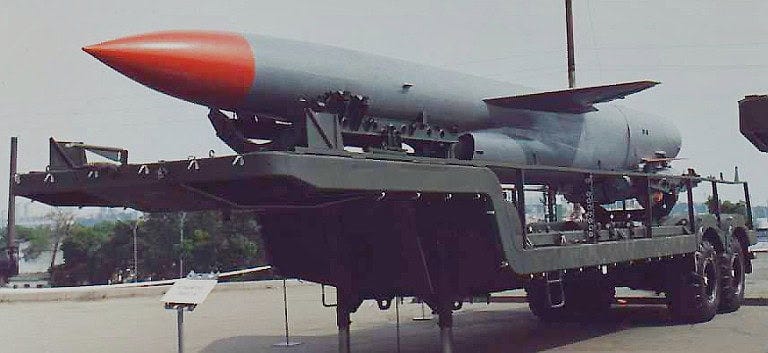
This was the first true end-to-end aircraft carrier kill chain, with every component designed from the ground up to destroy an American CSG specifically. The Soviets were the only power on earth with the resources and motivation to deploy the world’s first (nuclear powered!) dedicated naval ISR satellite constellation. But the Granit wasn’t fielded until 1983, and the full Legenda constellation wasn’t deployed until 1988. The program faced massive technical challenges and multiple major setbacks, which is unsurprising considering its complexity and ambition. Gorbachev cancelled it the same year the last satellite in the constellation was launched, and Legenda was already heavily degraded by the time the USSR collapsed in 1991. Legenda also lacked what we’ve already identified as the silver bullet for overcoming air defenses: an extremely fast, highly accurate anti-ship ballistic missile.
East Wind
The only nation that can make a plausible claim (emphasis on claim here) to having solved all the problems outlined above is China, which is unsurprising given that, just like the Soviets, they have both the resources and the motivation to push the state of the art forward in this area. Studying Chinese ASBM development can inform our analysis of Iranian efforts.
The Chinese have launched hundreds of ISR satellites into orbit, with their total in orbit increasing by a factor of six from 2018 to 2026. These include what are speculated to be dedicated constellations just for tracking American aircraft carriers. The scale of these constellations dwarfs Legenda’s, which could only provide short windows of active radar tracking. And crucially, the Chinese claim to have developed geostationary synthetic-aperture radar ISR satellites that allow uninterrupted tracking of an individual target, which is otherwise impossible given the narrow viewing window of SAR.
Combined with over-the-horizon radar, ship-based radar, and AWACS, it’s plausible to say that the Chinese are capable of knowing the precise location of an American aircraft carrier in the Pacific for lengthy, uninterrupted periods, or perhaps at all times. This is the first major problem to solve in developing a true carrier killer.
The Chinese fielded the first operational ASBM in history, the DF-21D, in 2010. Because the DF-21D has never been used in combat, and its specifications are classified, we can only speculate on how closely its claimed capabilities match reality. But its general profile is thought to be a maneuvering MRBM with a very low (estimates are 20 m) CEP, a terminal phase active radar seeker, and a 1500 km range. The DF-21D is commonly cited as having a Mach 10 “terminal phase,” though this is likely its speed at atmospheric re-entry. In order for the active radar seeker to function, it probably slows down significantly, to around Mach 2, before impact. This is how the American Pershing II IRBM worked, engaging in a “pull up” maneuver so its active radar seeker could compare the ground below it against preloaded terrain maps.
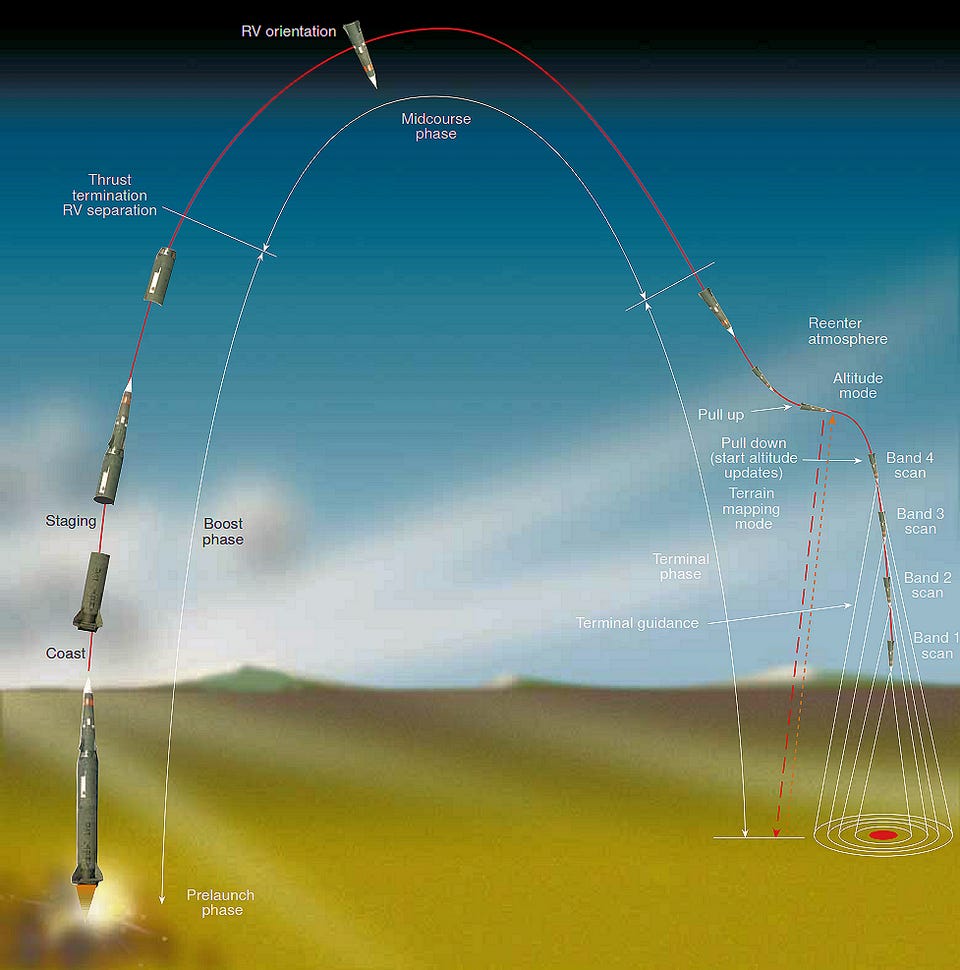
The Chinese have developed a succession of more advanced anti-ship systems since the DF-21D was introduced in 2010 (be warned, the following information is highly speculative). The DF-26 is an IRBM that builds on the DF-21D with nuclear capability and increased range. The Chinese have tested it against full-scale (non-moving) mockups of Gerald R. Ford-class carriers and Arleigh Burke-class destroyers. The YJ-20, a naval-launched, hypersonic ASBM, appeared in 2025. Its biconic design should theoretically allow much higher terminal speeds and greater maneuverability than a traditional blunt cone reentry vehicle.
Also of note are Chinese hypersonic glide vehicles (HGVs), of which it has fielded at least three. An HGV moves in a flat trajectory while skipping along the atmosphere. They trade raw speed at impact for maneuverability, and various militaries claim they’re capable of extreme maneuvers that would never be possible with a traditional missile design. Their trajectory makes them immune to high altitude defense systems like the THAAD and Arrow-3. The open question is whether any of these is truly capable of active terminal guidance against a moving target. There’s no real evidence they are, and even so, an HGV doesn’t necessarily impact its target at high Mach, making it theoretically possible for it to actively seek a target, but also feasible to intercept.
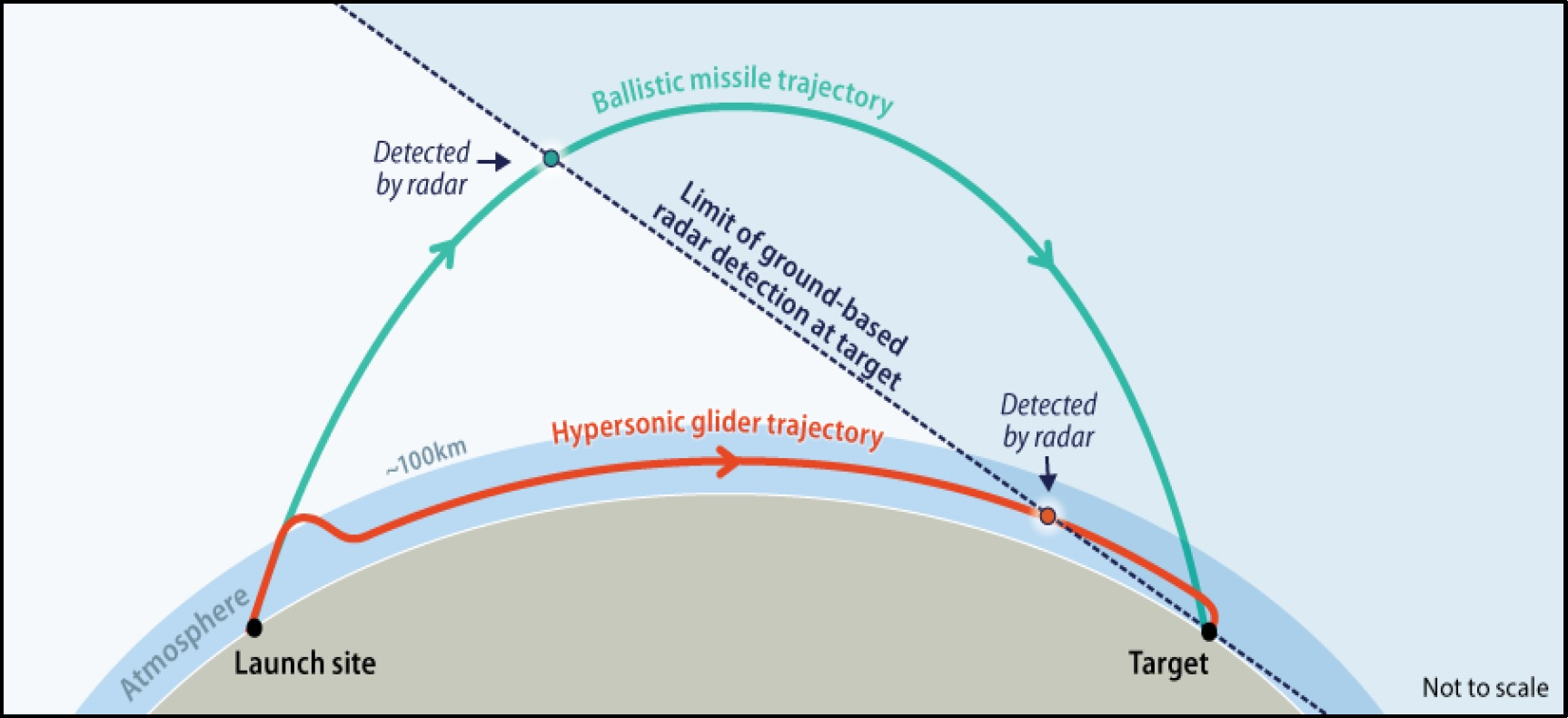
While it’s reasonable to assume that HGVs will defeat high-altitude naval defenses like the SM-3, which has a minimum intercept altitude around 100 km, lower-tier interceptors may still pose a threat to them. The high terminal speed/maneuverability combination that’s made Iranian missiles so deadly may not have an ASM equivalent due to the complexities involved in designing an active seeker that can function at high Mach.
There’s little public information on the state of the art in high-Mach seekers. The Iranians themselves appear to be pushing the envelope here and claim the Qassem Bassir, arguably the most advanced Iranian MRBM, is equipped with an infrared electro-optical seeker that functions at speeds greater than Mach 5, giving the system “meter-level” accuracy. But this is supposedly a scene-matching system designed for use against static land targets, freeing it from the constraints that make ASBMs so challenging to design. And there’s no evidence yet of the Mach 5 impact claim.
But there are reasons to think this problem is solvable. Here we step from the realm of the unconfirmed to the purely speculative. The Chinese have devoted enormous resources to plasma research, and Chinese scientists have claimed major breakthroughs in passing signals through plasma. Advancements here would go a long way towards resolving the fundamental constraints in ASBM design. The first is constant, external guidance at hypersonic speeds. We’ve already covered that a military actor like China can track the real-time position of a moving naval target using its ISR network. If that network can provide constant updates to a hypersonic missile during its flight, the pressure on the missile’s onboard seeker is greatly decreased because the search space shrinks massively. The Chinese have also possibly found solutions for seeking through the plasma sheath.
It’s plausible that the Chinese possess a reliable, operational carrier killer today, and that they’re the only nation to ever have one. But this should be regarded as a holistic system, rather than just a particular missile. All the components in a highly sophisticated and staggeringly expensive chain reaching from the launcher on the ground to ISR satellites in space must work together.
So where does this leave the Iranians? First, none of this proves Iran hasn't chosen restraint. What it does establish is that restraint is a more logical choice than it may at first appear. The Iranians don’t have the resources to create an integrated space-based ISR system like the Chinese have. Their coastal radars have suffered attrition. They’ve made massive leaps in missile technology, but this is just one link in a lengthy chain. Their best bet for the moment is attriting American naval defenses with cruise missiles and drones, but this is a tall and expensive order. A single CSG has hundreds of interceptors capable of shooting down slower aerial threats. Its radars, unlike the terrestrial ones the Iranians have already destroyed, are mobile. And American naval forces are intentionally operating at the edge of Iranian cruise missile range. The Iranians could expend hundreds of cruise missiles without much to show for it. Perhaps the most realistic possibility for the Iranians to get an edge on American naval forces would be getting a little help from their friends. Chinese and Russian ISR could greatly diminish Iran’s disadvantages in targeting, but it remains to be seen if either state would be willing to take that risk.
Do the challenges of interceptor missiles transfer to AshMs? An interceptor must also 1) be high speed 2) have guidance 3) hit a very fast moving target. By that logic you'd think any nation that can produce interceptor systems can also manage the kill chain on ships
Given that the Iranians have a very poor record of shooting down incoming missiles (do they even try?) and don't have a domestic industry for MANPADS or interceptors other than that S-300 variant, which was easy for the US to destroy, it may explain why their AshM tech just isn't a thing
My guess is their doctrine would be to 1) drone swarm, which would occupy defenses and identify the CSG 2) speedboat swarm, which brings the fight to close range and 3) overwhelm with very short range missiles with simple guidance. The problem with this doctrine is drones are slow and trivially easy to shoot down over the water, so you'd need a LOT of them, and the speedboats would be a single use strategy because most, if not all, would not survive the encounter. And carriers are FAST, so this whole approach only works as an ambush strategy.
Any way to get some actors onto that coast of Oman?