
PR War Ramps Up in Ukraine
Untangling the latest media web

Having faded largely into the constant background noise of the mainstream news cycle in recent months, and having been overshadowed by unprecedented geopolitical events in the Middle East, the war in Ukraine is back in the headlines. Casual consumers of world news have been presented with a series of startling narratives and images indicating that after years of apparent stagnation, the war may be reaching an inflection point favoring Ukraine.
A string of pieces in The Economist gives a sense of the shift: Is Russia Being Out-Droned? (May 5), Vladimir Putin is Losing His Grip on Russia (May 6), Russia is Stumbling on the Battlefield (May 10), Russia’s Crimean Conquest is Turning into a Deadly Mess (June 23). In Foreign Affairs: Ukraine Turns the Tide (June 1). CNN: Russia’s Winning Streak in Ukraine is Over (May 14). Anne Applebaum’s June 7th piece in The Atlantic was given the fascinating title Ukraine is Not Losing. Russia is Not Winning.
The broad narrative is as follows: after a clear Russian advantage on the battlefield during the past year, the Ukrainians have emerged from an organizational restructuring significantly stronger. The AFU’s desertion problem has been largely solved. Increased drone production is giving the AFU a numerical advantage in standoff strikes for the first time. Russian casualties have never been higher, with losses totaling as many as 30,000 personnel a month, and the Russians are unable to generate the recruitment rate to replace them. The average life expectancy of a Russian soldier sent to the front lines can be measured in minutes. Ukrainian attacks on fuel logistics both in Russian-held territory in eastern Ukraine and in Russia proper threaten the Russian army and Russia’s economy as a whole. The situation is so catastrophic in Crimea that for the first time since the failure of the 2023 summer offensive, Ukraine may stand a chance of retaking it. Incredibly, the Ukrainians are achieving these victories without American support.
All of these issues are pushing a ceasefire ever closer, and the Russians may have no choice but to give in. The domestic situation is highly unstable. Russian soldiers are rebelling, as is the Russian bureaucracy. Dissatisfaction with battlefield failures is sowing discontent among the Russian elite, and Vladimir Putin’s position is in more danger than ever. The imminent loss of Crimea threatens to trigger regime change in Russia. As I write this piece, some sources say a coup is currently underway in the Kremlin.
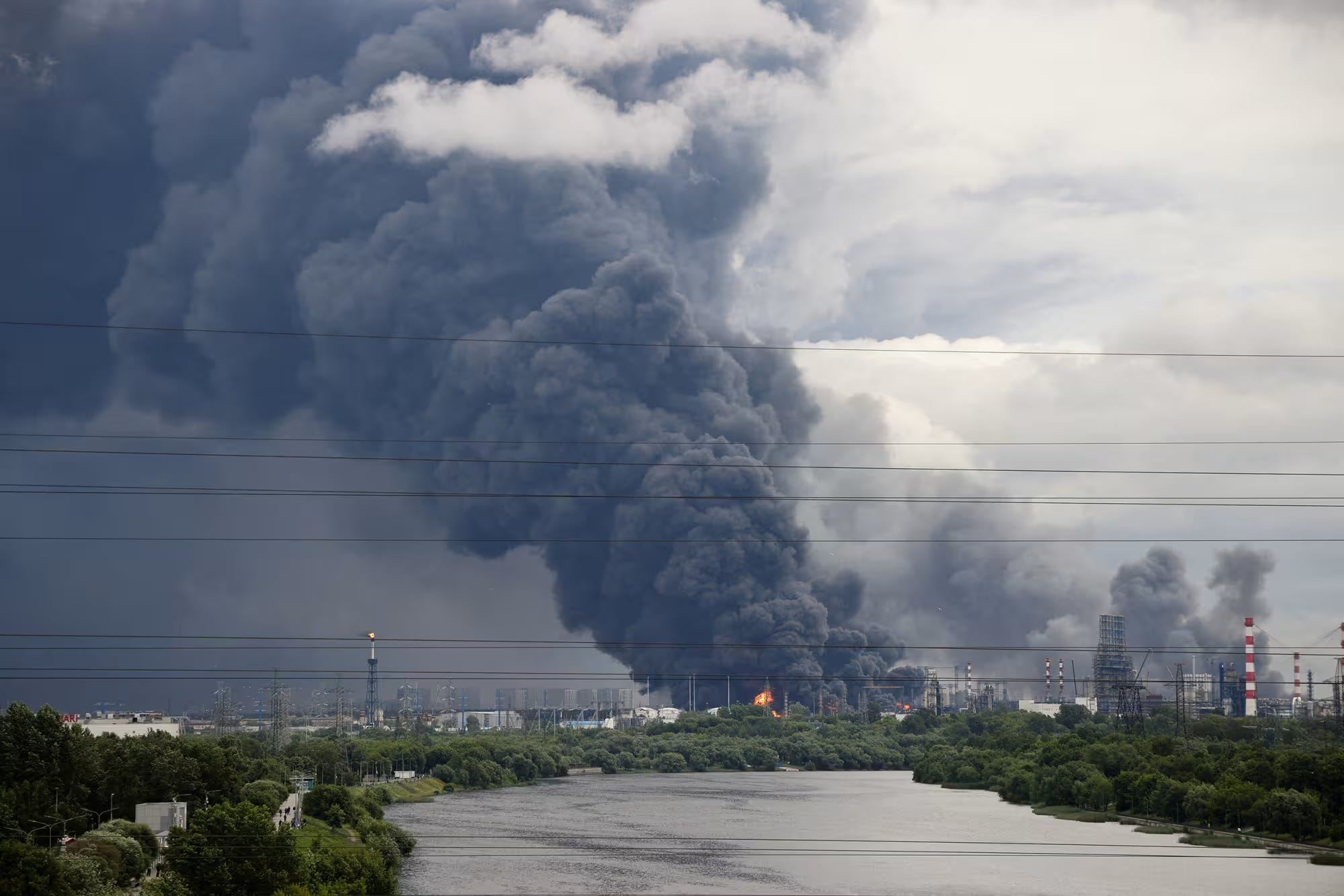
Shocking images from Russia itself bolster these narratives. Last week saw the largest Ukrainian drone attack on Moscow since the war began. Hundreds of Muscovites (who face no legal repercussions for doing so, unlike in Ukraine) readily shared videos of a major Moscow refinery burning. Long-range Ukrainian drones hit the cafeteria of a strategically vital semiconductor plant in Voronezh during lunch a week ago, wiping out dozens of irreplaceable skilled workers and shutting down a facility that manufactures components for Iskander missiles. Gasoline shortages are rippling through Russian cities as refineries and fuel storage are destroyed, with some stations running out completely.
With the tide turning, Belarusian president Alexandr Lukashenko quickly capitulated to Zelensky’s demands to shut down drone relays operating on Belarusian territory, lest he risk unspecified Ukrainian offensive action. Lukashenko was then summoned to Russia to face Putin before vanishing entirely. His fate is unknown, but he may be in Russian captivity.
And the Ukrainians are just getting started. Zelensky announced the beginning of a “40-day influence operation” two days ago. The explicit objective? To force the Russians to sue for peace. Russian military insiders and bloggers are understandably panicked.
Readers of this publication will be familiar by now with my preferred rhetorical structure for analysis of issues like this one. First describe the mainstream narrative in detail, then pick it apart in an attempt to glean the truth of it. And this piece will be no different.
First, the narrative should be viewed through the lens of the overriding pattern in Ukraine’s relationship with the western media. Long-term observers of the war will recognize this immediately from the experience of Ukraine’s 2022 counteroffensive, the 2023 summer offensive in Zaporozhye, the 2024 offensive into Russian territory around Sudzha, and previous waves of strikes on Russian oil infrastructure.
The pattern goes like this: official Ukrainian government statements and heightened, flashy military action coincide with a wave of think pieces in respected publications. The usual suspects are all here: Anne Applebaum, Ben Hodges, Ukrainian publications like the Kyiv Independent, The Economist, and so on. Algorithm tweaks on social media ensure the war comes front and center for a change. The same narratives are typically recycled: Russia is “running out” of something strategic (missiles, fuel, soldiers), the Russian government is on the verge of collapse (Putin has cancer, the elites are unhappy, a coup is in the works, the Russian economy is crumbling), the Ukrainians have obtained a game-changing weapon or strategy (western armor, HIMARS, long-range missiles, new drones), and the tide is turning on the battlefield.
The pattern has thus far always resulted in the same thing: the Ukrainian effort peters out, the war continues much as it did before—with a glacial Russian advance creeping its way across the Donbass, the Russian government more or less unchanged, and the Russian economy intact but never quite where Russian planners want it to be.
This doesn’t preclude that the strategic situation can change, but it tells us that skepticism towards Ukrainian triumphalism is warranted. Fool me once, and so on. In other words, the relationship between any given “Russia is collapsing” narrative and the truth of the matter should be considered unknown until clarity can be obtained by means that don’t take the propagators of said narrative as truthful.
So let’s try to do that. First: the structure of the AFU. The restructuring is indeed paying dividends, with the increased coordination of the corps-based structure helping to contain Russian breakthroughs in Dobropolye and Kupyansk.
The AFU’s desertion issue is a different matter. The tendency for Ukrainian soldiers to go AWOL is a natural consequence of forced mass mobilization, which is an absolute requirement to keep the AFU operating. As such, it’s a hard issue to solve. The Ukrainians have done so with a multipronged strategy.
First, in 2025 they classified desertion statistics, which were formerly widely published (even occasionally in the western press), as a state secret. This has reduced the reporting on the issue, though outlets like PBS have admitted desertions are “growing” well into 2026. Al Jazeera claimed 2025 was a record year for AWOL cases, which have “snowballed” with “half the country on the run” according to one AFU soldier. Second, the AFU has imposed draconian measures on its conscripts. The perimeters of training camps are mined, and beatings and torture have increased. Systematized murder of escapees is commonplace, with the deaths laundered as “pneumonia,” even in summer. Suicides within the ranks of the AFU have skyrocketed, and mobilization teams increasingly raid methadone clinics for recruits and target the mentally disabled.
With official statistics and objective reporting from Ukraine difficult to come by, we only have anecdotal reports from which to glean any strategic conclusions. But the broad image of an army with serious, but not catastrophic, manpower issues remains unchanged from last year.
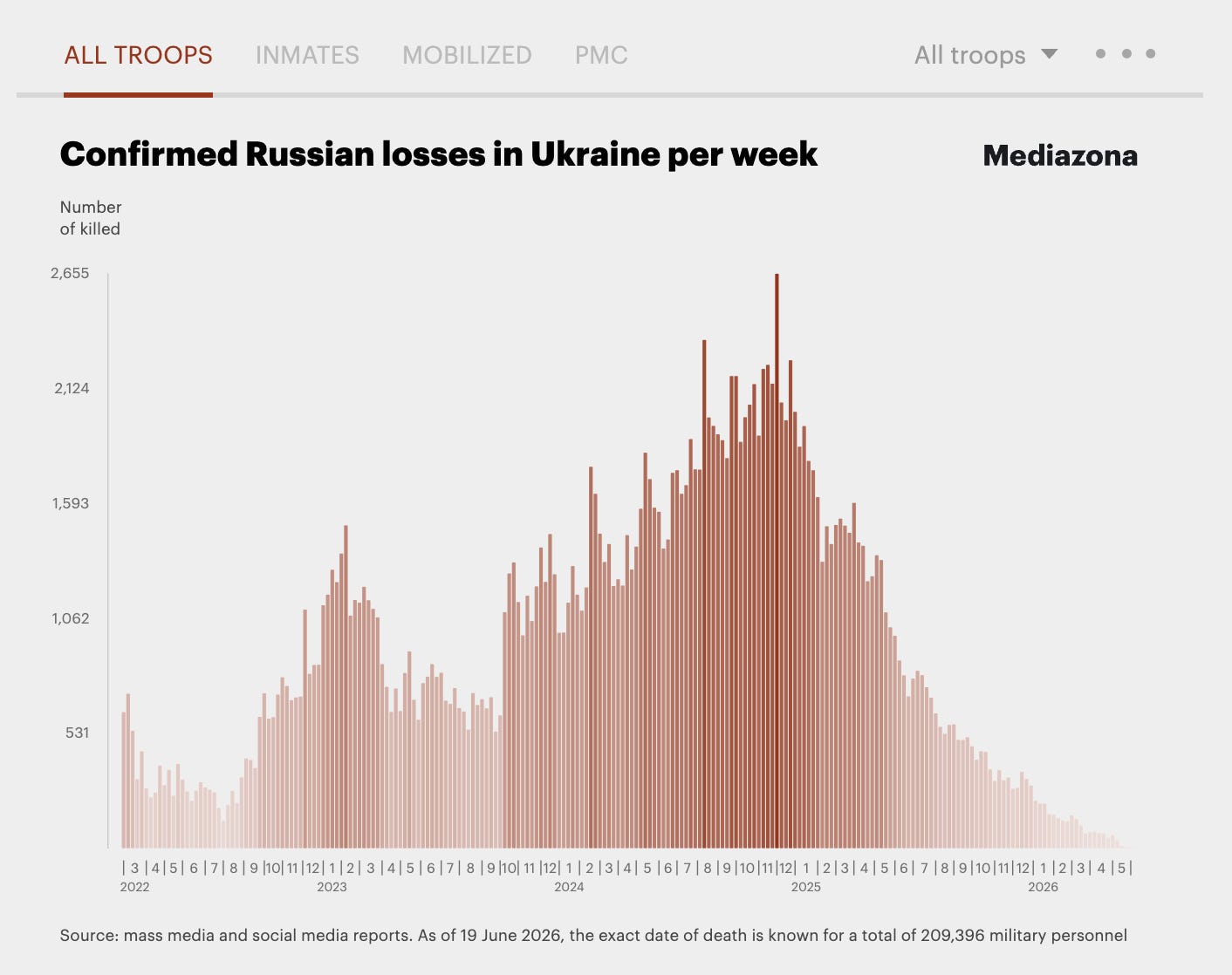
Ukrainian claims of massive Russian casualties are still fraught with self-contradiction and improbability. Mediazona, the only western-sponsored outlet that seems interested in mounting a serious effort at counting Russian losses, continues to estimate declining Russian casualties since a December 2024 peak. Mediazona has been accused of both gross over and undercounting, but their consistent methodology provides a useful yardstick and measures losses as a minuscule fraction of official Ukrainian claims. While AFU officials count as many as 30,000 unrecoverable Russian losses a month, Mediazona is finding as few as six confirmable Russian military deaths a week. Even if only one in one hundred Russian military deaths are confirmable with an obituary, news/social media post, or memorial, the numbers don’t add up.
The aforementioned contradiction is the result of Ukrainian planners needing to simultaneously sell their own success and bolster the case for Russia presenting a serious threat. AFU commander-in-chief Alexander Syrsky claimed the Russian grouping deployed to former Ukrainian territory alone has increased by 10,000 personnel since February, and another 10,000 since late last year. How the Russian military force in Ukraine could be steadily growing while suffering 30,000 losses a month—in the absence of forced mobilization no less—is unexplained.
On the frontlines, the situation looks much the same as in prior years. The Russian advance continues apace (slowly), with one or two mid-sized strategic cities (Konstantinovka and Kupyansk) looking likely to be taken this year. After its first year of the conflict with no major counteroffensive action, the AFU launched a minor counterattack on the southern front near Gulyapole. The results of this operation were ambiguous, with the Ukrainians claiming they spoiled a major Russian offensive, but little territory changing hands in absolute terms.
To elucidate this, we’ll use two timelapses. Both are from DeepState, an official organ of the Ukrainian government, and one notorious for delaying and underselling Russian gains. Therefore, we can take these as the rosiest possible interpretations of the AFU’s success so far this year. First, the Konstantinovka/Kramatorsk/Slavyank axis since the beginning of the year (consider increasing the playback speed on both of these. The difference in runtime is caused by lag in DeepState’s UI, it’s the same timeframe):
Next, the southern front, with the Ukrainian counteroffensive:
DeepState’s maps have become increasingly detached from reality since the Russian capture of Pokrovsk, and the outlet is currently delaying recognition of a widely reported (on both sides) deterioration of the AFU’s position across much of the frontline. Sudden Russian gains in Kupyansk, Vovchansk, Lyman, and Konstantinovka signal a small but strategically relevant shift in the balance of power on the front further towards the Russian advantage. As it stands, there’s little reason to doubt the Russians will take Kramatorsk and Slavyansk eventually, and AFU servicemembers acknowledge this on social media.
The Ukrainian drone campaign against Russian logistics nodes echoes the HIMARS campaign of 2022. The game-changer this time is the American Hornet drone, made by Eric Schmidt’s Perennial Autonomy. The drone is cheap, quiet, semi-autonomous, and better constructed than many flawed European and American competitors that have failed in Ukraine.
The issue with reading into the new Ukrainian campaign as a strategic turning point in the war is that it’s accompanied by a parallel Russian strike campaign against Ukrainian logistics, and one that’s at least as effective, and has been ongoing for much longer. And while the Hornet seems by all metrics a good drone, it isn’t substantially different from the current state of the art used in existing platforms on both sides, and it remains to be seen if it can be produced in the staggering quantities needed to keep the campaign going for the long term.
The strategic Ukrainian strike campaign has generated captivating videos and gasoline shortages, but this was the case for prior campaigns with inconclusive results too. As I’ve written previously, Russia is vulnerable to gasoline shortages because it only produces enough for domestic consumption. Russia can solve this through imports, exactly as Ukraine has. Ukraine imports more than 85% of its light petroleum products (for Russia, the share is typically zero), which exposes the country to supply shocks and drives prices at the pump to nearly double what they are in Russia. With Ukraine’s refining infrastructure long destroyed, Russia has increasingly targeted individual gas stations in Ukraine with long-range drones, in addition to targeting logistics lines with shorter-range drones.
The broad picture here is that whatever Ukraine can achieve with its drone campaigns, the Russians can hit back just as hard or, in most cases, significantly harder. The Ukrainians have no real answer to Russia’s massive deployment of glide bombs or comparatively vast quantities of missiles, a seemingly insurmountable asymmetry. Russian strikes on strategic Ukrainian targets are so constant they no longer make headlines. Occasional deliveries of western missile interceptors put temporary dents in Russian strike packages, but then dwindle.
Triumphalist pieces in the western press must answer a simple question: if a Russian air campaign of a given pace has thus far been unable to knock Ukraine out of the war, why would a Ukrainian air campaign of a comparable or smaller size do so to Russia?
What’s typically offered here is the bizarre and confused science of Kremlinology. Anonymous “insiders,” western intelligence reports made for public consumption, and exiles ready to tell the press what they want to hear combine to form a chorus that has been proclaiming the imminent collapse of the Putin regime since the first weeks of the war. To be sure, the Russian power structure is not monolithic, and dissatisfaction with the conservative strategy it has used thus far in the war is real, but so poor is the track record of Western analysis on this subject that my position is to discard its claims entirely and treat the internal situation at the highest levels of the Russian government as fundamentally unknowable. Even more mystifying is the idea that a replacement would somehow be less hardline than the notoriously cautious Putin.
Instead of reading the tea leaves, let’s break things down in a deliberately simplified analysis of the strategic balance, which has remained unchanged for most of the war. This will not be exhaustive, but it will help elucidate my point.
Ukrainian advantage:
Ukraine’s military and government are funded externally; it effectively receives military equipment free of charge. It has no need to operate a functioning state economy in the traditional sense.
Forced mobilization guarantees an influx of personnel.
Much of the AFU’s logistic chain is outside Ukraine, where Russia so far refuses to strike.
Sanctions punish the Russian economy at no cost to Ukraine.
Russian advantage:
Russia’s manpower pool is around five times larger than Ukraine’s, though without conscription, much of this pool is untouched. This allows an all-volunteer army, reducing domestic tensions and the perceived costs of war.
A massive advantage in glide bombs, non-drone standoff weapons, and air power.
Russia’s huge territory makes some infrastructure very hard for Ukraine to hit, while Russia can easily hit any target in Ukraine.
The Russian defense industry has punched well above its weight, even outproducing what NATO is able or willing to send Ukraine in key areas like artillery shells, air defense interceptors, and long-range missiles.
Russian economic planning and workarounds have offset a surprising amount of damage from sanctions.
After the chaos and territorial reshuffling in the opening phase of the war, little has changed here, and the result is a grinding Russian advance that will eventually take all of the Donbass unless something dramatic shifts. Ukrainian hopes that Russia will sue for peace without such a shift lack justification. Any edge in drone technology will eventually be obtained by the other side. By way of example, the deployment of Russia’s Rassvet satellite constellation is underway, eroding the most important Ukrainian edge in the drone war: its exclusive use of Starlink since the beginning of this year.
Nullification of one or more of Russia’s strategic advantages will be necessary if the Ukrainians seek to truly “turn the tide” of the war.
PR War
For a keen and long-term observer of the war, the sudden ramp-up of triumphalist narratives in both the mainstream and social media is obvious. Influencers sound the alarm on coups in the Kremlin (attributed to sources that say no such thing), murdered generals (retired, known to be sick, in their 70s), a vanishing Lukashenko (he made public appearances hours afterwards), and so on. Even real Ukrainian drones hitting structures in Moscow appear to be overloaded with fuel to cause the most dramatic explosion possible (note: I was in Moscow during the largest drone attack in two years - I didn’t realize it had happened until I opened Telegram hours later. It’s a big city). All of this plays much the same as similar campaigns of the past, featuring starving Russian soldiers and an AFU poised to roll all the way to Crimea.
The question, then, is why now? If a large, international public relations apparatus has been spun up and is firing on all cylinders at this point in time, as opposed to three or six months ago, there must be a reason. While the Ukrainians claim they hope to force the Russians into agreeing to a ceasefire imminently, this seems fantastical. We’ll explore some of the other possibilities below.
Tactical Considerations
While the true purpose of the 2024 Kursk Incursion continues to be debated, the predominant explanation from the Ukrainian side was that it was designed to force the Russians to shift their forces away from the front line in the Donbass. If this was the true goal, it was nonsensical and a failure. But a similar goal to pressure the Russians to redeploy valuable air defense assets to protect the homeland could be advantageous. Despite all the obvious evidence from the Middle East pointing to it as an impossibility, the popular idea is that Russia should be capable of entirely protecting its strategic assets and population centers from Ukrainian drones. Even with relatively impressive air defense performances like a >96% interception rate (8 out of more than 200 drones made it through) for the drone raid on Moscow on the 18th of this month, all it takes is a few hits to generate viral videos that have an impact on the Russian population. Russians exposed to the Western media will be subject to the PR push, increasing the pressure.
Battlefield Failures
After the Ukrainian counteroffensive earlier this year fizzled out (with significant casualties), and with the Ukrainian position in the Slavyansk/Kramatorsk/Konstantinovka axis degrading, this campaign could be designed to distract from the AFU’s increasingly hopeless chances of holding on to what’s left of the Donbass.
Preparing for A New Offensive
It’s possible the AFU will launch an offensive of some kind to coincide with this media push. This was the pattern in 2023, and it wouldn’t be surprising to see it happen again. 2025 was the first year with no major Ukrainian offensive operation, and this can either be read as the AFU conserving its strength for a later offensive, or as a sign that its offensive ability is largely spent, and not likely to return. At the current moment, there’s no strong evidence for this explanation.
Angling for Aid
A key part of the narrative the western press is pushing is that Ukraine is achieving its recent successes without American help. This narrative is mostly false, as Ukraine continues to receive shipments of American weapons through the PURL program (paid for by European taxpayers), reduced levels of direct aid, significant American targeting and intelligence support, benefits from US sanctions on Russia, and enjoys exclusive use of Starlink on the battlefield. Nevertheless, if Ukraine is turning the tide without serious American aid, it bolsters the Ukrainian argument that it could achieve an outright victory with it. The Trump admin’s position towards Ukraine appears to be softening behind the scenes, so the Ukrainians may be playing to pull Trump back onside.
Ukrainian competition for military aid with Israel and other Middle Eastern states has never been more fierce. As many as 1,700 precious Patriot interceptors (and around half of US stocks) have been expended in the war with Iran so far. Replacements will be slow to arrive, and will have to be distributed across half a dozen US allies in the region. It’s essential for the Ukrainians to demonstrate that munitions sent there won’t be going to a losing cause, and it belongs at the front of the queue.
Another possibility is that the Trump admin is already onside, and this dual military/media operation is a signal of that. Events in the Middle East may have shifted American thinking, with planners preparing for renewed support of the Ukrainian war effort. In this universe, the media is dancing to a tune originating from the American government, rather than Ukraine itself or Europe. Ukraine’s mid-range drone campaign is relying on an American drone after all, and its long-range campaign may hinge on American ISR.
Preparing for a New Phase of War
If there’s any truth to the western claims of discord in the Kremlin over the pace of the war, it’s possible the Ukrainians are anticipating Russian escalation. This dovetails with rumors that have recently appeared in Russia itself that a new draft wave will occur after the Russian election in September of this year. A new draft could facilitate major Russian offensive operations next year, full Russian control over the Donbass, and the expansion of the buffer zone on the northern front.
As mentioned earlier, Russia’s much larger manpower pool has allowed it to maintain an all-volunteer army, minimizing the perceived costs of war on the home front. A new draft will increase domestic tensions, while for the first time leveraging one of Russia’s key advantages in the conflict: that it can heavily outnumber the AFU.
For Ukraine, these tensions can theoretically be escalated by portraying a draft as an act of desperation by a Russian government that knows it’s losing the war. Portraying Putin as a desperate madman clinging to a losing position has been a throughline of Ukrainian propaganda, featuring heavily in the recurring news cycle that the Russians are “considering” deploying nuclear weapons in Ukraine. An objective observer might see a major Russian mobilization as a potential war-ending development to Ukraine’s disadvantage. It’ll be important for the Ukrainians to get out in front of this.
Setting the Stage for an Exit
With full Russian control over the Donbass looming as a potential threat, the Ukrainians may be preparing the ground for an end to the conflict. This could take various forms. They may be looking to negotiate from a position of relative strength, using up as many drones as possible in a final push before trying to work out an agreement. The offer of another limited “energy” ceasefire heading into what will likely be Ukraine’s most difficult winter yet has more weight after a successful offensive drone campaign. They may be proposing a freeze along the borders of the annexed Russian territories, since they appear set to be pushed back to them anyway (Kherson oblast is a major question there). The drone/media campaign allows the Ukrainians to control the framing of what would have been unthinkable two years ago, when the official objective was “1991 borders.” The Russians wanted to take all of Ukraine, the narrative would go, but we forced them to capitulate here.
This explanation would make the most sense if the Ukrainians were indeed preparing to make major concessions, considering the Russian government appears more adamant than ever that the war will be fought to its military conclusion.
I’ll wrap it up here. Setting the PR push aside, the most important signal I’ll be watching in the coming weeks is the Ukrainian ability to sustain its mid and long-range drone campaign.
It's worth noting that Russia prefers to rotate troops, and the September mobilization would correspond with de-mobilization of the previous cohort, who have been active for quite some time.
There is undoubtedly a desire in the West to shift the equilibrium into which the conflict has fallen; either toward negotiation on their terms, or obvious retaliation that they can spin to their populace(s) as full war. Full war would mean narrative freedom to oppress opposition voices even more than presently, and help stabilize shaky regimes from populist forces. There is also a very strong element of the persistent Russophobia of now centuries vintage, however "Russia is never as weak as imagined, nor as strong as it is supposed."
I see precisely zero evidence that General Milley wasn’t correct when he said in November 2022 that Ukraine “had reached the high water mark” and would never be in a better position to conduct a negotiated settlement to the end of the conflict … 🧐