
Debasification
Iranian air war strategy
Over the past few days, the US/Israeli/GCC (“US Axis” from here on) war against Iran has reached a pace not seen since the opening hours of the conflict. Waves of Iranian missiles and drones have been striking targets across the region, with an apparent shift in target selection concentrating unprecedented amounts of Iranian firepower against Kuwait and Jordan.
The war between the US Axis and Iran can be arbitrarily divided into several theaters. There’s the war for control over the Strait of Hormuz, countervalue strikes against infrastructure, Iran’s campaign against Kurdish proxies staging for ground operations on its western flank, and so on. Today we’ll be focusing on a narrow slice of the conflict: the air war, with IRGC missile and drone forces (IRGCASF) on one side and the USAF, IAF, and GCC air forces on the other. As we’ll see, this theater of the war has profound implications that cut across all other areas of the conflict.
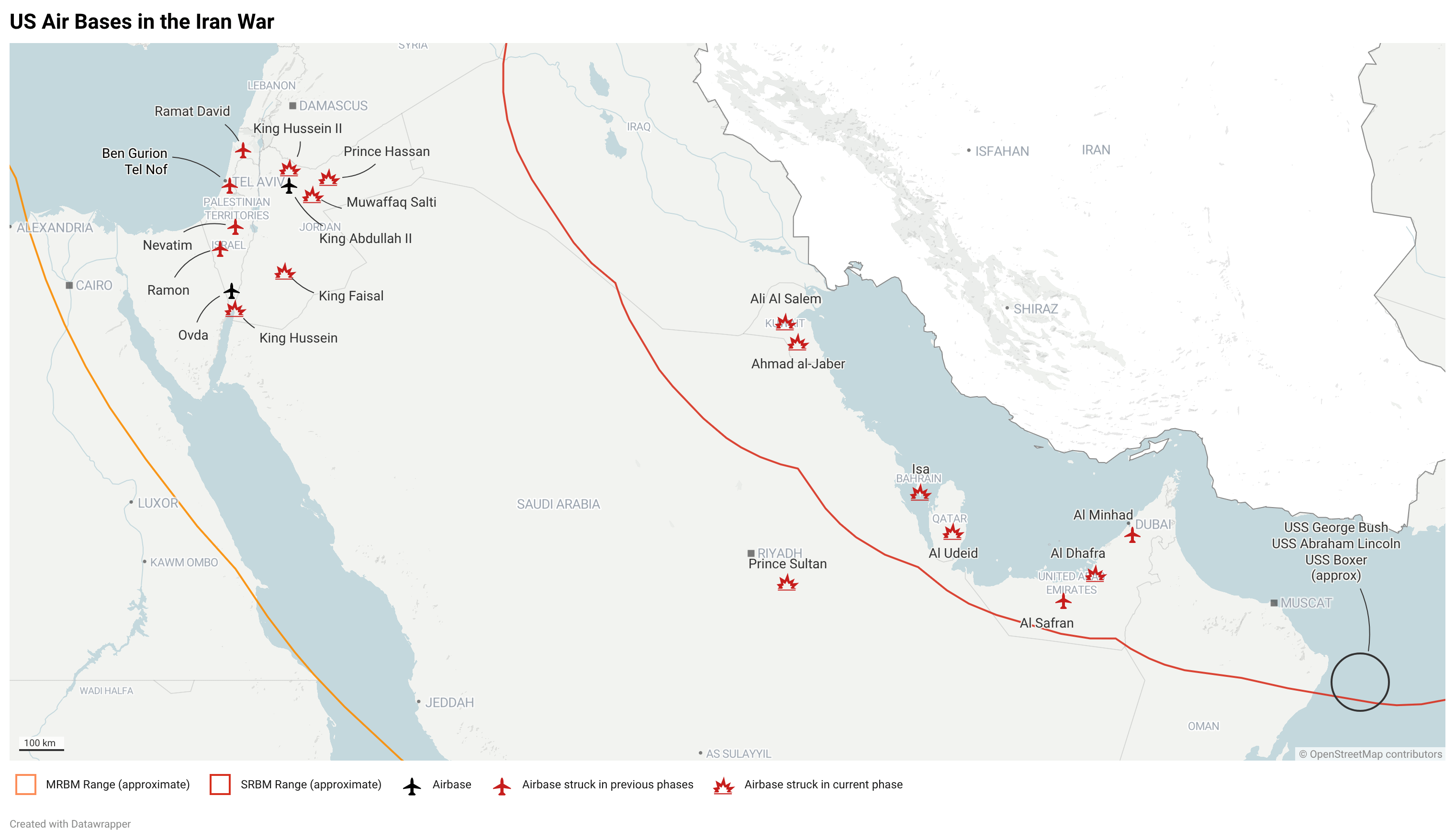
The broad picture of the Iranian air war in this phase has been a steady wave of concentrated missile and drone strikes sweeping its way across the region. In contrast to the previous hot phase of the war, in which Iran targeted bases across the entire theater simultaneously, this wave started with the targets close to Iranian shores, and has progressed steadily to the Israeli border. After destroying much of the radar network protecting regional US Axis bases in the previous hot phase of the war, Iranian planners have prioritized targeting fuel storage, drone hangers, refueling tankers, and barracks. The American response has been to pull assets back ever further from Iran, to bases in Israel and Jordan. We’ll call this process debasification. Iran’s debasification strategy takes advantage of the inherent asymmetry between the vastly different force structure and capabilities of Iranian rocket forces and US Axis air forces.
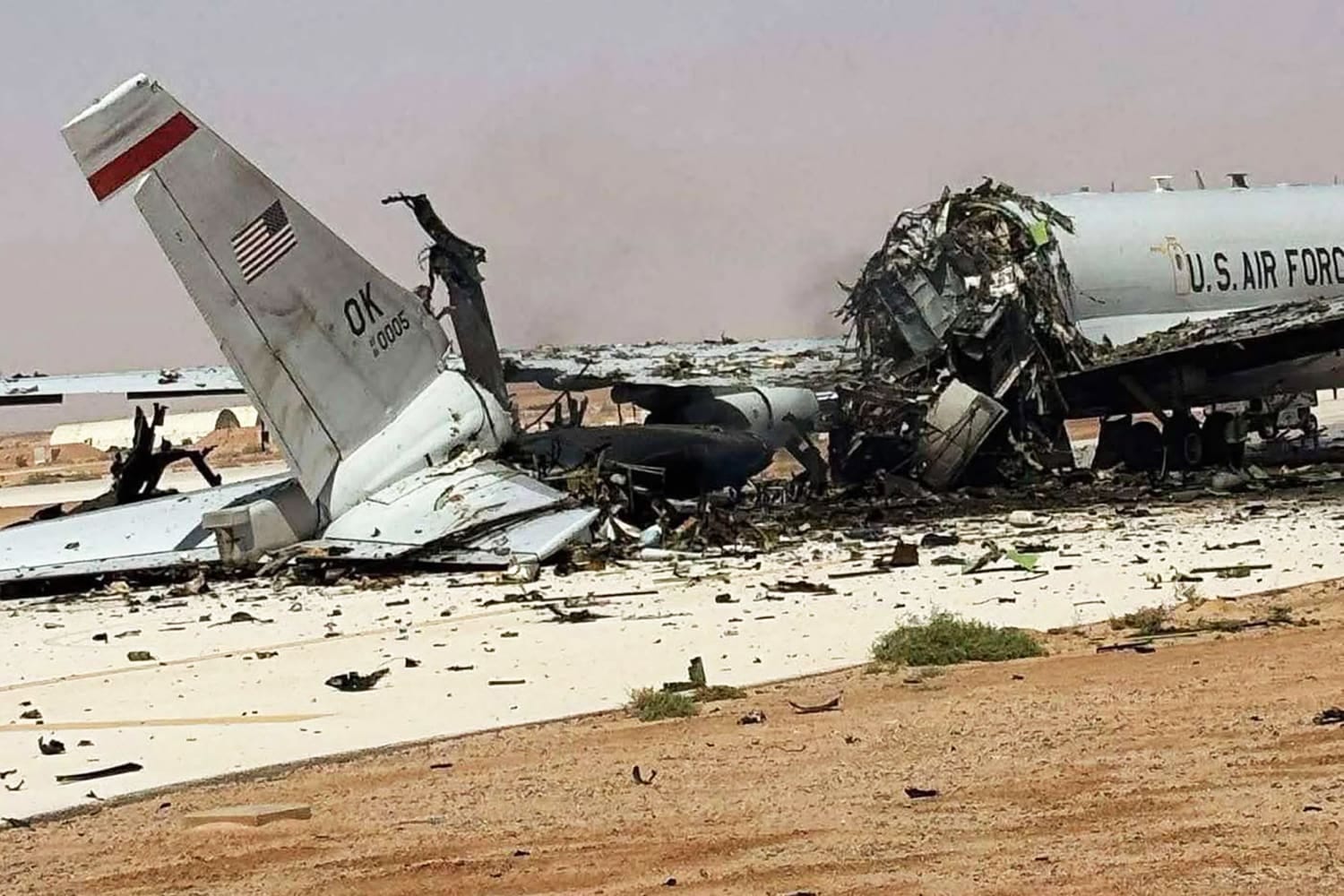
The first asymmetry we’ll cover is the American need for casualty avoidance. Political support for the war is low, and US narratives to shore it up hinge on overwhelming American superiority and a perception of the war presenting minimal risk. Casualties and the loss of major assets fly in the face of this narrative and erode support for the war. The Department of War clearly takes this seriously, as evidenced by their decision to evacuate the most vulnerable bases (moving personnel to hotels) before the war began. When the US force in the region has taken major risks by leaving valuable assets in the open at bases subject to Iranian targeting, the results have been disastrous, with the loss of near-irreplaceable assets like the E-3 Sentry destroyed on the tarmac at Prince Sultan Air Base in Saudi Arabia. Iranian military sources claimed to have damaged refueling tankers on the ground at Al Udeid in Qatar, Al Kharj in Saudi Arabia, and Muwaffaq Salti in Jordan in a single wave of attacks on Friday.
Multiple US personnel were killed and as many as dozens injured two days ago in an Iranian missile attack on Muwaffaq Salti Air Base in Jordan. Subsequent disclosures from the New York Times revealed that this was the fourth Iranian attack on Jordan to result in casualties and major losses of air assets in the previous week. A strike on King Faisal Air Base days prior wounded five, and another attack on a base—unidentified by the NYT but confirmed by mappers to be Prince Hassan Air Base—damaged multiple Black Hawk helicopters on the ground. Then, 20 personnel were wounded in an attack on Muwaffaq Salti on the 16th. The attack that killed at least two US personnel occurred the next day.
The Iranians have thus forced American planners into an uncomfortable choice. Jordan was the clear fallback point for assets that previously operated out of bases closer to Iran in Bahrain, Kuwait, Qatar, and the UAE. But Jordanian bases are not safe, with the US taking dozens of casualties and losing an unknown number of air assets in the span of just five days. Footage of Iranian MRBM strikes within Jordan reveals an appallingly low interception rate for US and Jordanian air defenses, even when interceptors are expended in 3:1 ratios and above against incoming projectiles. Official Jordanian attempts to cover this up by claiming 100% interception rates have been conclusively disproven by such a mountain of visual evidence and reporting they can be dismissed out of hand.
The next line of bases for US air forces to fall back to is within Israel itself. While falling back to Israel will bring US assets within the protective range of Israeli air defenses, it isn’t clear that the Israelis want any part in this phase of the war. There’s also little reason to think they’ve been able to replenish their own interceptor stocks in the brief pause in the fighting, and the IDF was facing a crisis in that area before the pause. Even when interceptors were more plentiful, the Israelis were unable to fully protect their own airbases.
The US force in the region losing access to both the first and second lines of airbases available to it at the start of the conflict is a development with profound strategic and operational consequences. Depending on how you slice it, the number of airbases from which the US would likely conduct operations against Iran prewar was around 20. Without access to bases in Kuwait, Bahrain, Qatar, the UAE, KSA, and Jordan, that number will be cut to around five. This will compress hundreds of airframes into just a handful of tarmacs and runways, making it impossible to get those assets into the air in the time between early warning radars detecting an Iranian MRBM launch and that missile impacting its target in Israel. With more assets on the tarmac, the Iranians are much more likely to score hits. As the Pentagon moves more assets into the region to stage for a potential ramp-up in attacks on Iran, this issue will compound.
Enter a second asymmetry: the US Axis depends on aerial refueling to generate combat power, and the distance that makes Israeli bases safer to conduct operations from undercuts refueling missions. Tankers that could have met attack aircraft for refueling missions directly over their takeoff point at Al Udeid in Qatar, for example, will now have to fly over a thousand miles to reach the southern border of Iran, and even farther if they want to avoid dangerous airspace over Iraq. This puts stress on airframes, sucks up fuel, and reduces the number of refueling missions that can be flown. These distances become extreme when considering that tankers may have to meet attack aircraft launched from carriers operating as much as 1,700 miles away from Israel in the Arabian Sea. The retreat to Israel effectively divides the US forces in the region in two, splitting USAF assets in Israel from USN assets off the coast of Oman.
The key to the American air campaign has always been to degrade Iranian air defenses to the point that cheap and plentiful glide or even gravity bombs can be used against targets in Iran. Dwindling stocks of long-range cruise missiles make this a necessity. To accomplish this, American air forces have to conduct Suppression/Destruction of Enemy Air Defenses (S/DEAD) operations, which require long loiter times with aircraft remaining in the air to respond to ISR and emissions from air defense radars. These missions are exceptionally dependent on tanker support, so any degradation of US tanker operations in turn degrades American S/DEAD capabilities.
By all available evidence, the Iranian debasification campaign appears to be working. The US force in the region is likely incapable of generating the same combat power in its air operations against Iran as it could when the war started, and things are trending ever further in a negative direction. Even worse, there’s no clear solution on the horizon. The most obvious lever for American planners to pull is to accept more casualties and losses of personnel and airframes, but this is an unprecedented step the modern incarnation of the US military has never faced.
Great article. I have been following you on x since the beginning of the war and have really enjoyed your analysis as someone who knows very little about combat. Looking forward to more.
Great news. Hopefully Iran has gamed out the very likely scenario of a nuke attack by the Zionists, and has a war ending counter strike.