
Von der Leyen Goes Off the Rails
Insanity in Brussels
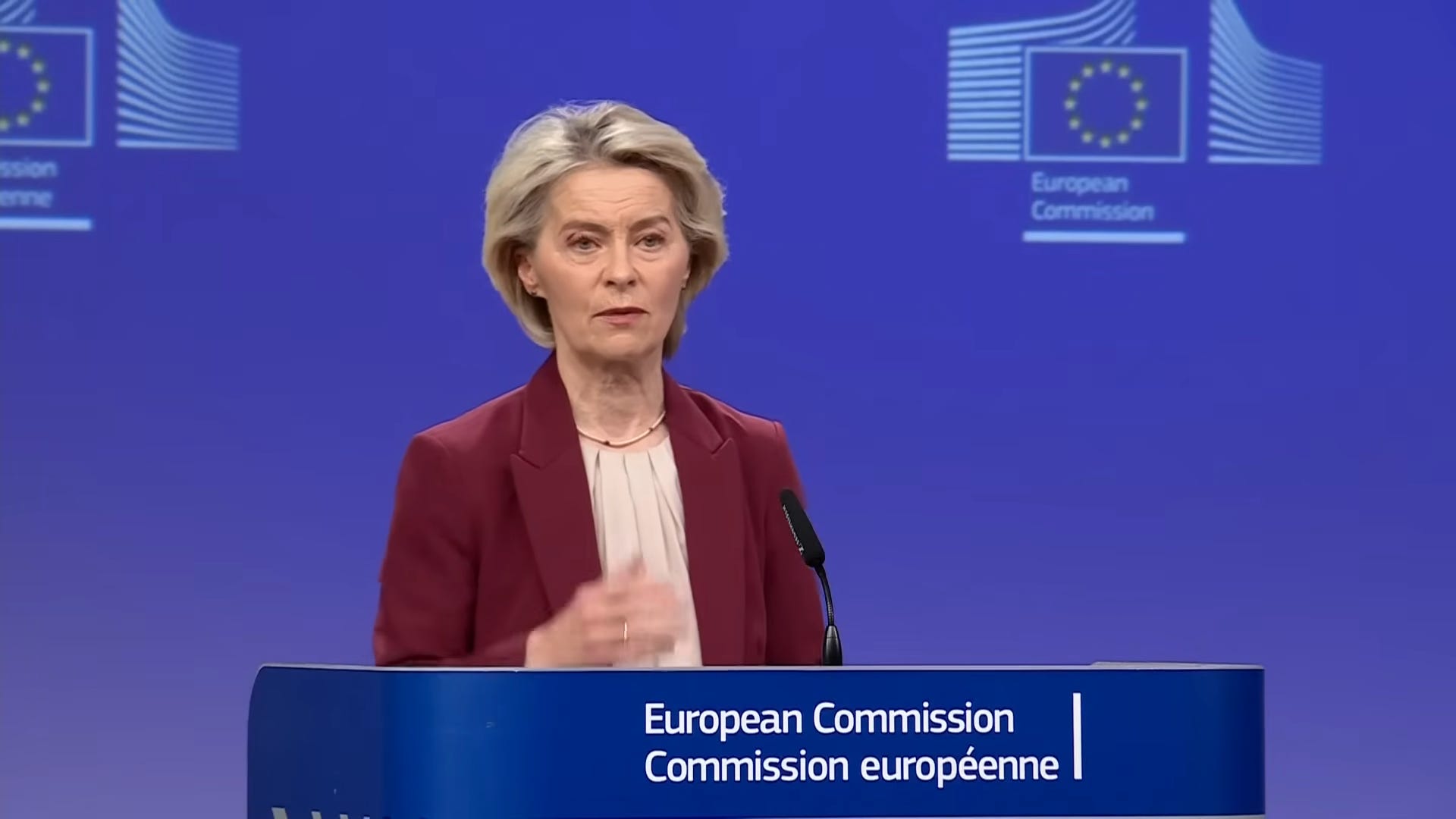
In an address to the European Commission this morning, Ursula von der Leyen revealed the “legal solution” to untying the complex knot the Europeans find themselves in with their reparations loan scheme. To unblock the loan, the EC must solve the following problems:
Convincing the Belgians to transfer the Russian assets they hold in Euroclear to the European Commission. The Belgians have demanded that:
They be backstopped for the entire $215 billion of Russian assets they hold.
Other EU countries (Germany, France) move their frozen assets too.
The backstop be immediately transferable to the Belgians upon the end of the war or discontinuation of the sanctions regime.
Acquiring unanimous support for the scheme, because any one state can potentially veto it.
Acquiring unanimous support to extend the sanctions that keep the Russian assets frozen. Currently, they must be renewed by vote every six months. Any one EU state can veto the extension.
Von der Leyen’s solution is simple: invoke the emergency powers afforded to the EU in Article 122 of the EU treaties to prevent any EU state from transferring any Russian assets back to Russia. If you’re scratching your head, you’re not alone, because it isn’t obvious how this solves any of the issues listed above except issue #3.
Article 122 affords the European Commission the right to invoke temporary emergency measures without the consent of the European Parliament in the event of “severe difficulties” of an economic nature, like natural disasters. Only a qualified majority of EU member states within the EC is required to approve an Article 122 invocation, instead of a unanimous vote. It was widely used during the Covid-19 pandemic to fund unemployed programs and vaccine purchases.
So how can Article 122 be invoked to indefinitely extend the sanctions that trap Russian assets within the EU? The European Commission’s justification is that if the reparations loan is issued and a member state vetoes the extension of the sanctions regime, the ~$212 billion liability will pose an existential threat to the European economy because they’ll have to pay the Russians back.
If this doesn’t make sense, let’s put it a different way. The EU is saying it will invoke emergency powers to protect itself from something that can only happen if it invokes those same emergency powers. This circular justification, in which by intentionally creating a massive financial risk for itself, the EU can circumvent all normal democratic procedures and justify taking the risk, is bizarre and unprecedented. Article 122 is already deeply controversial and has been singled out as a major threat to democratic principles within the EU framework. The EC is currently embroiled in a lawsuit with the EU Parliament over an earlier invocation of emergency powers to fund a loan scheme for EU defense procurement. To propose using Article 122 in this way signals extreme desperation on the part of the European Commission.
Predictably, the reaction to this plan has been negative. A diplomat quoted in the Financial Times said the idea was “crazy” because there is “clearly not an economic emergency in the internal market.” The player holding all the cards here is, of course, Belgium, and it should be unsurprising that a ramshackle and openly undemocratic solution to the problem is unlikely to satisfy them. Before von der Leyen even made her speech, Belgian Foreign Minister Maxime Prévot said the proposals “do not address our concerns in a satisfactory manner.” Prime minister Bart De Wever specifically singled out prolonging sanctions through a majority (meaning through emergency powers) as dangerous: “These risks are unfortunately not academic but real… we’re not going to risk hundreds of billions on Belgium. Not today, not tomorrow, never.”
Pieter Cleppe, in a scathing critique posted in the Brussels Signal earlier today:
Today the European Commission decided to ignore Belgium’s concerns, presenting its plan anyway, not only proposing to use the Russian assets, but even claiming that this can be decided with a qualified majority of EU member states – 55 per cent of member states comprising 65 per cent of the EU’s population. In other words, the European Commission thinks it should be possible to outvote Belgium on a decision which according to the Belgian government risks the bankruptcy of the country. This is completely without any precedent and can serve as more evidence of how out of control the institution led by von der Leyen is.
The Belgian position is understandable, because freezing the Russian assets in the EU under emergency powers seems no safer than dealing with a potential veto, as it will almost certainly face legal challenges. If a legal challenge succeeds, the legislation created through the Article 122 invocation will be void, which is potentially just as damaging as a veto. Diplomats briefed on the EC’s legal arguments say that Article 122 may also be used to change the interval in which the sanctions regime is extended from every six months to every three years. EU states outside von der Leyen’s coalition have little reason to agree to any of this, because it fundamentally undermines their position. If the precedent is that the EC can intentionally generate a crisis whenever it wants and use that crisis to sideline parliament and effectively deny the right of veto to any individual EU state, much of the EU will be giving up substantial power.
Regardless, without approval from Belgium, von der Leyen’s proposal is dead on arrival. Perhaps sensing this would be the case, she offered a fallback plan: loaning the money to Ukraine straight out of the EU’s budget. But as we’ve covered previously, there’s even more internal resistance to this plan than to the reparations loan scheme. European governments have no interest in raising hundreds of billions of euros out of their own pockets and have publicly signaled their opposition to doing so.
At this point, it’s difficult to see what the purpose of this charade is. Short of tearing up the EU treaties or threatening Belgium itself with sanctions, the European Commission doesn’t appear to have any cards left to play. We’ll have to wait and see if the EC has an ace up its sleeve for the climactic meeting scheduled for the 18th.
It may appear to be a charade, but has anyone told UVDL? I expect she expects this to work.
Further, when this truly comes to a head and Ukraine actually runs out of money, the choice of "break laws, precedent, violate democracy" or "Ukraine loses", do you really think the former will be so important? They are all in, including the detractors
Could it be that some people in the European elite receive some of the billions that are being sent to Ukraine back on their accounts? Could it be that the longer this European aid lasts, no matter how, the longer this money laundering can continue? Ukraine is known as one of the most corrupt countries in the world, but there have been a few scandals proving that the EU elite is not as clean as one would wish. Think of Federica Mogherini, former High Representative, who is under suspicion of corruption. That's a big fish, part of the European elite I'm referring to.